
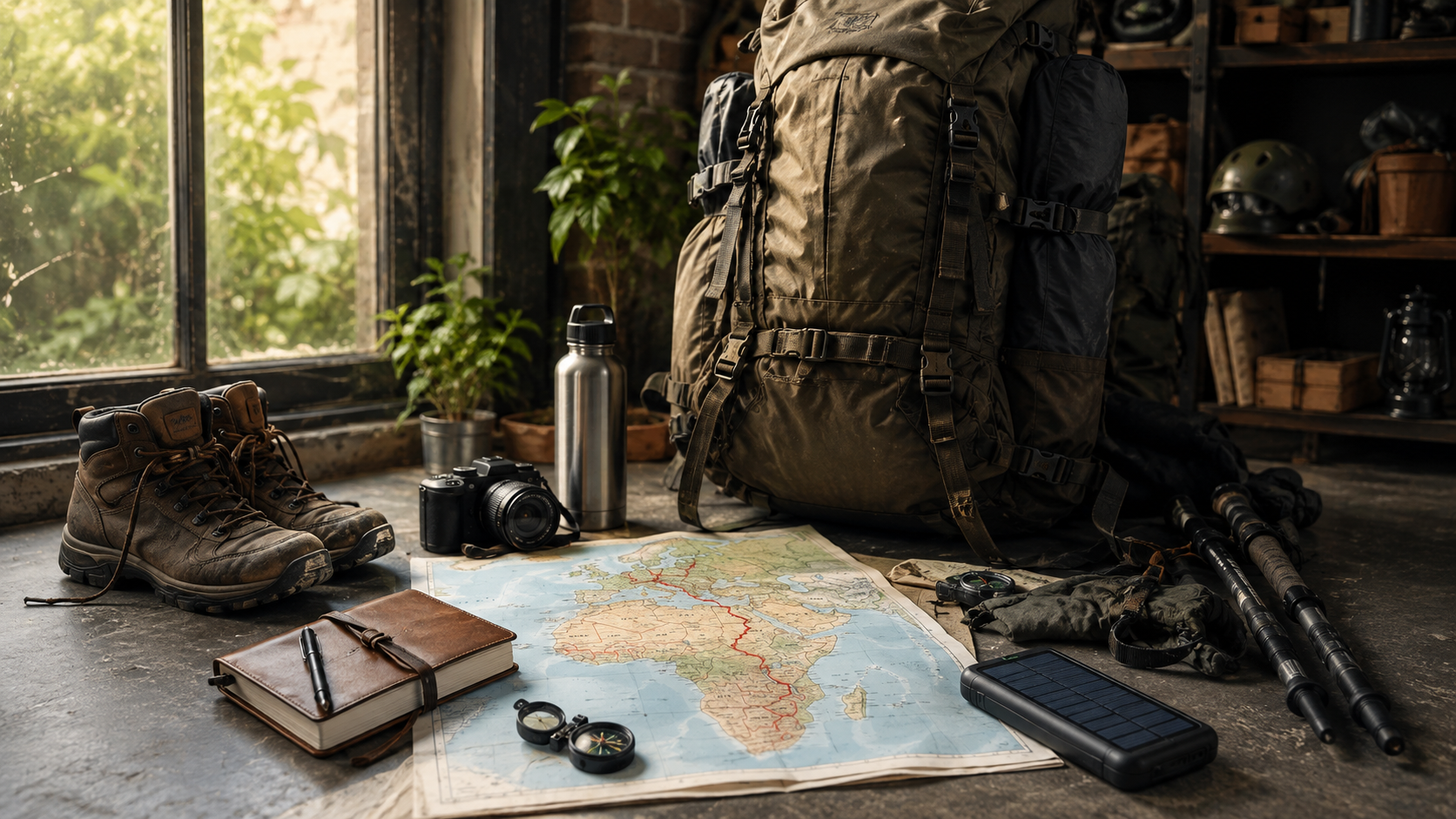
Every long journey begins long before the first step is taken.
HavikWay is currently in the preparation stage for an ambitious long-distance walking expedition that will begin in Amsterdam, the Netherlands, and gradually continue across countries, continents and very different environments.
The idea is simple to describe but far more demanding to accomplish: travel primarily on foot, experience the world at human speed, meet people along the way and document the reality of the journey as it unfolds.
Preparation has already started
At the moment, the focus is not on covering kilometres. It is on building the foundation that will make those kilometres possible.
Equipment is being researched and selected, routes are being studied, border requirements are being checked, communication systems are being prepared and the technical infrastructure behind HavikWay is being developed.
Every decision matters when everything needed for daily life may eventually have to be carried in a backpack.
A route across continents
The first major section of the journey is planned to begin in Amsterdam and continue south through Europe toward Spain and Morocco.
From Morocco, the expedition is intended to continue through Africa toward southern Africa. Future stages are planned to lead north again toward Egypt, through the Arabian region and onward toward Pakistan, China, Mongolia and other parts of Asia.
The route is intentionally flexible. Conditions on the ground, borders, visas, weather, safety and local circumstances can all require changes.
HavikWay is therefore not about following an artificial line on a map at any cost. It is about building a realistic, responsible route one stage at a time.
Choosing the right equipment
One of the most important parts of the current preparation is equipment selection.
A long-distance walking expedition requires a balance between reliability, weight and independence. The backpack, shelter, sleeping system, clothing, water equipment, navigation devices, cameras, power banks and solar charging equipment all have to work together.
Equipment that performs well during a weekend trip may behave very differently after weeks or months of continuous use.
For this reason, equipment will be tested before the expedition begins. Items that prove unnecessary, too heavy or unreliable can be replaced before they become a serious problem thousands of kilometres from home.
Navigation and communication
Navigation will be another essential part of the expedition.
GPS devices, offline maps and satellite communication are being considered as part of a system designed to keep the route documented and provide a way of communicating even in areas where normal mobile coverage is unavailable.
HavikWay is also being developed to eventually provide live or delayed location information so that people following the expedition can see how the journey is progressing.
Documenting the road
This journey will not only be recorded through kilometres on a map.
Photography, video, journal entries and field updates will document the landscapes, roads, challenges and people encountered along the way.
Cameras and lightweight filming equipment are therefore being evaluated with the same care as traditional expedition equipment.
The objective is not to turn every moment into a production. The objective is to preserve authentic moments from the road and share stories that would otherwise remain unseen.
Researching borders, visas and safety
An expedition crossing many countries requires considerable administrative preparation.
Visa requirements, permitted border crossings, entry conditions, travel documents and local regulations have to be researched country by country.
The same applies to climate and security.
A route that appears straightforward on a map may pass through deserts, tropical regions, high-altitude terrain, areas with extreme seasonal temperatures or locations where travelling on foot requires additional precautions.
Some sections may ultimately have to be modified or avoided entirely.
Preparing physically and mentally
Walking day after day with a loaded backpack places very different demands on the body compared with occasional hiking.
Training will therefore be progressive. Longer walks, consecutive walking days and equipment tests will form part of the preparation process.
But physical preparation is only part of the challenge.
A journey of this scale also requires patience, discipline and the ability to adapt when plans change. There will inevitably be difficult days, unexpected delays and situations where progress is slower than expected.
HavikWay is being built around the journey
Alongside the physical preparations, the HavikWay platform itself is being developed.
The website will become the digital home of the expedition, bringing together the route, live tracking, journal stories, photographs, videos, country information, statistics and future field updates.
As the project develops, visitors will be able to follow individual stages of the journey and understand not only where the expedition is, but what is happening along the way.
More than reaching a destination
There will be distant destinations on this journey, but reaching one particular point on the map is not the only purpose.
Travelling on foot changes the relationship with distance. Cities are no longer separated by a few hours of transportation. Landscapes are crossed kilometre by kilometre. Weather cannot simply be observed through a window. Communities are approached slowly rather than passed at motorway speed.
That slower perspective is central to HavikWay.
The expedition is intended to create opportunities to meet people, understand places more closely and, where possible, contribute something useful to communities encountered along the route.
The first chapter starts now
There is still significant work ahead before departure.
Routes must be refined. Equipment must be tested. Documents must be prepared. Costs must be calculated. Systems must be built. Training must continue.
And that is precisely why the story begins now rather than on departure day.
The preparation, uncertainty, decisions and mistakes are all part of the expedition.
Future journal updates will document this process step by step — including equipment choices, training walks, route planning, visa research, technology tests and the final preparations before departure.
The road may begin in Amsterdam, but the journey has already started.